







In many ways, we live in the era of the side hustle. Everyone seems to have one, two, or sometimes three things going on outside their main job, school or business. For young Nigerians, side hustles have become more than a way to make extra cash. Against inflation, economic uncertainty and a constantly shifting job market, they have become an increasingly important way to stay afloat.
From selling thrift clothes on Instagram to writing articles for clients abroad, managing social media pages or driving for a ride-hailing app after work, Nigerian youth are finding increasingly creative ways to turn their skills, networks and free time into income.
Here are seven of the side hustles helping keep Nigerian youth afloat.
1. E-commerce / Online Selling

Selling online is arguably one of the clearest side hustles of the moment, and the numbers back it up. A 2026 survey by The Garage of more than 4,000 Nigerian students across 55 tertiary institutions found that 44% of student entrepreneurs run e-commerce businesses, while another 22% are involved in trading.
For many, the business doesn’t require a website or physical shop. More than half of the student entrepreneurs surveyed primarily use WhatsApp to conduct business, while Instagram accounts for another 18%.
The staying power is notable, too. 96% said they intend to continue their businesses after graduation, suggesting that what starts as a university side hustle can easily become a full-time business.
The category covers everything from thrift fashion and clothing to beauty products, food, accessories, skincare and other consumer goods. And the wider gig economy is moving in the same direction: a 2026 Ipsos study commissioned by Bolt estimated that e-commerce accounts for 38% of Nigeria’s gig economy, compared with 24% for ride-hailing.
For a generation that has grown up selling, shopping and socialising through their phones, it is natural that the line between having an online store and simply having a business is becoming increasingly blurry.
2. Freelance Writing & Content Services

For young Nigerians with a laptop, an internet connection and a decent command of words, writing has become one of the easiest skills to turn into income.
The Garage’s 2026 study found that 38% of student workers are involved in writing services, making it the largest individual category in its student-work data. That covers everything from copywriting and article writing to ghostwriting, editing and research. And unlike businesses that require inventory or physical infrastructure, freelance writing can be done from almost anywhere, with clients often based outside Nigeria.
The numbers also challenge the idea that every young person trying to make money online is trying to get into tech. Only around one in five student workers surveyed worked in specifically tech-oriented roles. For many others, the opportunity lies in turning existing skills into services that can be sold remotely.
In other words, the laptop is the office, and the internet is the marketplace.
3. Social Media Management & Digital Marketing
Some young Nigerians are making money from social media without becoming influencers themselves. Instead, they’re managing the accounts of the people and businesses that want to be online. The Garage found that 15% of Nigerian student workers surveyed work in social media management, while 25% work in marketing.
It’s an increasingly accessible hustle because the barrier to entry can be relatively low. A young person with an understanding of Instagram, TikTok, WhatsApp, content creation or digital advertising can start by managing a friend’s business page and eventually build a portfolio of clients. And businesses clearly need the help. Research from the State of Entrepreneurship in Nigeria found that 85.3% of youth-led businesses use social media and digital marketing, making social platforms an important part of how young businesses find and communicate with customers.
The result is a new class of young workers whose job is essentially to make sure everyone else looks good online.
4. Content Creation & Influencing

Content creation has gone from something young people did for fun to an industry with its own infrastructure, business models and career paths. Nigeria was estimated to have more than 250,000 active content creators and influencers in 2026, according to a mid-year industry outlook reported by Punch.
And the audiences are huge. Figures from the 2025 Nigerian Creator Economy Report, released by the National Council for Arts and Culture, indicate that Nigerian content generates around 20 billion YouTube views annually, while more than 1,500 Nigerian YouTube channels have surpassed 100,000 subscribers.
The money can come from brand partnerships, platform monetisation, affiliate marketing, appearances, UGC and, increasingly, products and businesses built around a creator’s audience. For many young Nigerians, the appeal is obvious: instead of waiting for an institution to give you an audience, the internet lets you build one yourself.
5. Ride-Hailing & Driving
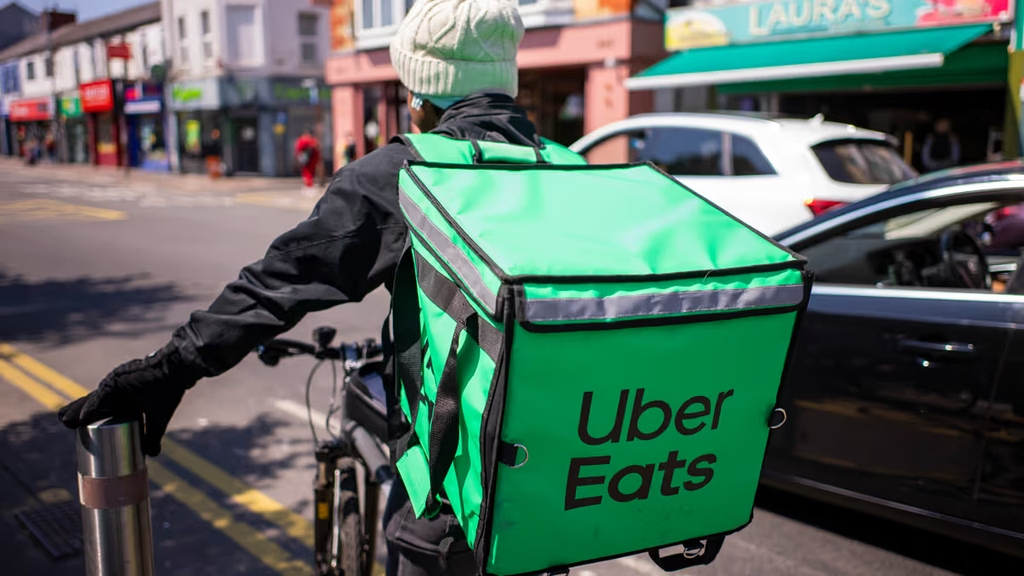
Ride-hailing remains one of the most visible forms of Nigeria’s gig economy, particularly for people looking for flexible ways to earn around another job or business.
An Ipsos study commissioned by Bolt estimated that Nigeria’s gig economy was worth $5.17 billion in 2026, with ride-hailing accounting for 24% of the sector. The research also estimated that roughly three million Nigerians participate in gig work. And this isn’t necessarily a temporary hustle. The study found that 59% of ride-hailing participants had remained active on platforms for more than a year.
The appeal is straightforward: unlike a conventional second job, driving can be fitted around an existing schedule. Someone can work during evenings, weekends or other periods when they have time available. But the scale of the sector also shows how much the definition of work is changing. What was once simply “driving for extra cash” has become part of a multi-billion-dollar platform economy.
For young Nigerians navigating an unpredictable labour market, flexibility itself has become a form of income.